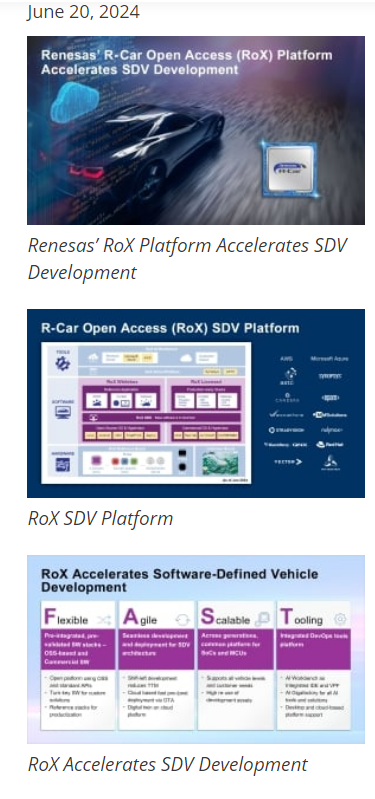
Renesas’ R-Car Open Access Platform Accelerates Software-Defined Vehicle Development With Market-Ready Software

Release time:2024-06-20
author:AMEYA360
source:Renesas
reading:1661

  Renesas Electronics Corporation (TSE:6723), a premier supplier of advanced semiconductor solutions, today launched R-Car Open Access (RoX), a development platform for software-defined vehicles (SDVs) that integrates all essential hardware, operating systems (OS), software and tools needed for automotive developers to rapidly develop next-generation vehicles with secure and continuous software updates. Designed for the Renesas R-Car family of system on chips (SoCs) and microcontrollers (MCUs), the SDV platform includes comprehensive tools for the seamless deployment of AI applications. By pre-integrating all fundamental layers required to develop SDVs, RoX drastically reduces the complexities for car OEMs and Tier 1 suppliers, saving time and money.
Renesas’ R-Car Open Access Platform Accelerates Software-Defined Vehicle Development With Market-Ready Software

  The advent of SDVs represents a major step forward in automotive technology – accelerating toward more driving autonomy, electrification and connected experiences. Cars have to be aware of the 360-degree surrounding space with ASIL D levels of sensing, processing and control to deliver safety and autonomy applications. The in-cabin experiences for drivers and passengers are being revolutionized. As a result, modern electrical/electronics (E/E) architecture depends on software to control vehicle functions, manage real-time data networks across different ECU zones, and provide customer differentiation. It has become more difficult to maintain and upgrade these complex software stacks while ensuring the highest levels of safety. Renesas’ customizable solution solves these challenges by offering a cloud-native development environment and a simulation platform, supporting the software-first approach and parallel hardware and software development.

  Out-of-box Platform with Market-Ready Software Stacks

  The flexible RoX SDV platform is available in two versions. “RoX Whitebox” is an open, easily accessible software package that includes royalty-free OS and hypervisor software such as Android Automotive OS, FreeRTOS, Linux, Xen and Zephyr RTOS, as well as reference applications designed for specific domain systems. “RoX Licensed” is based on industry-proven commercial software solutions, such as QNX and Red Hat In-Vehicle Operating System, as well as AUTOSAR-compliant software and SAFERTOS®. It is pre-integrated and tested to run on Renesas’ R-Car SoCs and MCUs and includes pre-validated software stacks from STRADVISION for Advanced Driver Assistance Systems (ADAS) and Candera CGI Studio for in-vehicle infotainment (IVI), to name a few. These software solutions can be easily productized and customized or expanded depending on OEMs’ needs.

  With the RoX SDV platform, automotive system engineers can start building their software immediately using a highly integrated toolchain even before the hardware is available. This is made possible through the cloud environment and the virtual development platform, which let developers design, debug in simulation, and verify their software before deploying on live SoCs and MCUs. The virtual development platform includes the Renesas Fast Simulator (RFS) as well as partner solutions such as ASTC VLAB VDM and Synopsys Virtualizer Development Kit (VDK) to provide broad coverage of simulation speed, features and use cases.

  For seamless end-to-end AI development, RoX offers the AI Workbench to enable developers to validate and optimize their models and test their AI applications all in the cloud, either on the virtual development platform or on Renesas board farms. A wide range of AI models, automated pipelines, as well as a specific hybrid compiler toolchain (HyCo) are available to support the rapid AI deployment on the R-Car heterogeneous compute platform across generations of SoCs.

  AWS Cloud Services Now Available

  The RoX SDV platform now supports Amazon Web Services (AWS) cloud computing services as part of the AI Workbench development environment. With the Renesas R-Car SDK (Software Development Kit) containerized in the AWS cloud environment, developers can innovate and optimize their designs more efficiently. This tight integration allows them to simulate and test hardware and software combinations instantly and deploy AI applications that seamlessly run on R-Car devices.

  Scalable R-Car Gen 5 Family

  The RoX SDV platform is designed for current generation R-Car SoCs, the upcoming R-Car Gen 5 MCU/SoC Family, and future devices. The SDV platform provides car OEMs and Tier1 suppliers the flexibility to design a broad range of scalable compute solutions for ADAS, IVI, gateway and cross-domain fusion systems as well as body control, domain and zone control systems.

  Renesas’ R-Car Gen 5 is currently the only hardware architecture in the industry that can accommodate the full range of processing requirements – from zonal ECUs to high-end central compute, serving from entry-level vehicles to luxury-class models. Thanks to a new unified hardware architecture based on Arm® CPU cores, customers developing with the R-Car Gen 5 devices will be able to reuse the same software and tools across diverse E/E applications that span car models and generations, preserving their engineering investments. Renesas’ high-performance SoC products will offer both domain-specific and cross-domain solutions using application processing, large display capabilities, sensor connectivity, GPU and AI processing.

  “RoX is a significant advancement that will speed up the shift-left approach for software-defined vehicles,” said Vivek Bhan, Senior Vice President and General Manager of High Performance Computing at Renesas. “Today, car OEMs and Tier1 suppliers are heavily investing in software development and maintenance. Renesas understands this challenge and is closely working with them to deliver a flexible, ready-to-deploy development solution that can be maintained throughout the vehicle’s lifespan. The RoX platform empowers our customers to design vehicles that deliver new value and bring improved safety and delightful comfort experiences to drivers and passengers.”

  “At AWS, we’re committed to helping our customers and partners accelerate development and bring innovation to drivers faster than ever before,” said Andrea Ketzer, Director of Technology Strategy, Automotive & Manufacturing at AWS. “With Renesas’ R-Car Gen 5 devices supported by the AI Workbench on AWS, customers will achieve faster and more validated simulations and the ability to develop independently of hardware. This step change in development will drive the industry forward and place software innovation at the forefront of mobility.”

  According to TechInsights, the market shift to domain, zonal and centralized architectures will translate to a growing processor market, incorporating SoCs and MCUs, worth $25.9 billion by 2031. “Being able to maintain and upgrade complex software stacks that incorporate operating systems, hypervisors and other functional software stacks will thus become an increasingly critical element of the supply chain,” said Asif Anwar, Executive Director of Automotive End Market Research at TechInsights. “By also being able to offer cloud-native environments to support a software-first approach to development and testing of the hardware, the Renesas RoX SDV platform offers a ready-built ecosystem that encompasses these elements in support of a scalable portfolio of next generation R-Car Gen 5 processors to address this sizable market.”

  Renesas’ R-Car Open Access Platform is being demonstrated at the AWS Summit Japan in Tokyo from June 20-21.

  RoX SDV Platform Partners:

  Operating System/Hypervisor Partners

  QNX

  Red Hat

  Vector AUTOSAR

  WITTENSTEIN SAFERTOS®

  Software Stack Partners

  Candera CGI Studio

  EPAM AosEdge

  Excelfore eSync

  MM Solutions

  STRADVISION SVNet

  Nullmax

  Development Tools Partners

  ASTC VLAB Works

  Synopsys Virtualizer Development Kit (VDK)

  Cloud Partners

  AWS

  Microsoft Azure

  Availability

  The R-Car Open Access Platform is available today with the option to license. Open-source OS, commercial OS, full application software stacks, virtual development, cloud infrastructure and debugging and emulation tools are available by Renesas or through partners. Additional information about the development platform is available here and information about the R-Car Gen 5 Family can be found here. Please contact your local sales teams for more details.

("Note: The information presented in this article is gathered from the internet and is provided as a reference for educational purposes. It does not signify the endorsement or standpoint of our website. If you find any content that violates copyright or intellectual property rights, please inform us for prompt removal.")

Online messageinquiry

reading
Renesas Announces General Availability of Renesas 365
  Renesas Electronics Corporation (TSE: 6723), a premier supplier of advanced semiconductor solutions, today announced the general availability of Renesas 365, Powered by Altium, an intelligent, model-based platform that integrates device exploration, model-based system development and early concept validation on a single unified platform. Built on a cloud environment, Renesas 365 is an industry-first platform designed to bring silicon and systems together across an open ecosystem at scale.  In modern embedded design, engineers often struggle with disconnected workflows, manual component searches and limited system-level awareness. Renesas 365 directly addresses such challenges by connecting previously isolated tools such as embedded software files, datasheets and application notes into a streamlined, cloud-managed platform. With Renesas 365, engineering teams can collaboratively explore architectures, co-develop hardware and software and make system-level design decisions backed by real-time insights.  Following its concept introduction, Renesas is now launching the first phase of Renesas 365 by integrating over 550 variants of the RA family of microcontrollers (MCUs), an industry-leading Arm®-based MCU portfolio together with a full suite of development tools.  Using model-based evaluation and optimization technology, engineers can now rely on Renesas 365 as an intelligent design environment that actively assists with selecting the right MCU based on full system requirements. Rather than filtering datasheets in isolation, engineers receive guided recommendations informed by pin usage, peripherals, timing, power and how devices align with system building blocks. This means tasks that typically take an engineer an hour reviewing data sheets and tool requirements can now be accomplished in minutes, dramatically reducing evaluation time. This system-level intelligence accelerates design convergence, minimizes downstream rework and enables faster time to market while supporting more robust, efficient and cost-effective embedded designs.  “The general availability of Renesas 365 marks a pivotal milestone in realizing Renesas’ Digitalization Vision,” said Gaurang Shah, Vice President and General Manager of Embedded Processing at Renesas. “By delivering the first phase of an intelligent design environment that supports early-stage development, we are laying the groundwork for the next phase, where hardware and software subsystem elements will be maintained within Renesas 365. This helps our customers build, scale and sustain next-generation software-defined products faster and at lower cost.”  Together with the e²studio integrated development environment (IDE), Flexible Software Package (FSP) and smart documentation, engineers can leverage integrated design workflows specifically created for RA MCU devices, including sensing, power management and compiler support.  Key features of Renesas 365 include:  Model-based component and system exploration, discovery and selection  Digital continuity across systems, hardware and software workflows  AI-assisted guidance on design constraints, resource management, and error resolution  Over-the-air (OTA) device management for RA MCUs  Existing customers can link their current projects in e²studio with Renesas 365 and start using the platform immediately, while developers starting a new project are guided through system-level component and solution discovery to identify compatible devices and evaluate feasibility. This system-level context awareness significantly accelerates early-stage development and reduces iterations.  Digitally Connected Hardware and Software Configurations  As engineers make modifications to their system, the platform automatically records iterations and connects them with system-level design elements so teams can revisit any previous hardware and software configurations. With a context-aware smart system, Renesas 365 helps identify resource or design constraints, suggests resolutions and assists teams to make design decisions with fewer iterations and confidence. Moreover, Renesas 365 lets customers manage and update RA-based devices even after initial design through an integrated over-the-air (OTA) capability.  An Open Platform Built for Flexibility  Renesas 365 is an open, scalable platform that mirrors how electronic systems are developed in the real world. Developers have the option to incorporate third-party components, sensors and partner tools directly into their system designs. This open approach allows teams to evaluate tradeoffs and consider mixed vendor architectures to customize solutions with integrated system-level context.  Growing the Renesas 365 Ecosystem  Now under development, the next phase of Renesas 365 will pave the way for completed subsystem building blocks to be modeled as platform-maintained components. As part of this effort, more Renesas product families will be supported, and the component ecosystem will include more third-party devices. Subsystem components such as peripheral configuration, power management and software will be automatically defined, maintained and validated for compatibility. With these customizable building blocks, customers will accelerate time to market, reduce engineering effort, and gain access to cutting-edge technologies.  Renesas will showcase Renesas 365 at embedded world 2026 in Nuremberg in two separate locations.  Renesas 365 Booth (Hall 4, Stand 305/4-305): Dedicated to the Renesas 365 solution, Booth 4-305 will feature live demonstrations on integrated RA workflows, model-based system exploration and intelligent validation.  Renesas Booth (Hall 1, Stand 234/1-234): Showcasing products across Renesas’ comprehensive portfolio of leading-edge semiconductor solutions with presentations and demos.
2026-03-18 13:11 reading:230
Renesas Develops SoC Technologies for Automotive Multi-Domain ECUs Essential for the SDV Era
  Renesas Electronics Corporation (TSE:6723), a premier supplier of advanced semiconductor solutions, has developed three System-on-Chip (SoC) technologies for automotive multi-domain electronic control units (ECUs). They feature advanced AI processing capabilities and chiplet functions, serving as the core technology platform for next-generation automotive electrical/electronic (E/E) architectures. Renesas presented the results at the International Solid-State Circuits Conference 2026 (ISSCC 2026), held February 15–19 in San Francisco, USA.  In the age of software-defined vehicles (SDVs), automotive SoCs require advanced performance to run multiple applications simultaneously and must offer scalability through chiplets. They must also meet the functional safety requirements of automotive SoCs. As multi-domain SoCs powering central computing are growing larger and more complex, maintaining automotive-grade quality is becoming more difficult. With increased performance in advanced SoCs, power consumption also rises, making improvements in power efficiency and safety vital. To meet these needs, Renesas has developed the following new technologies.  1. Chiplet architecture that supports functional safety  To meet the functional safety requirements of automotive SoCs, Renesas has developed a new, proprietary architecture that supports ASIL D even in a chiplet configuration. By combining the standard die-to-die UCIe interface with a proprietary RegionID mechanism, the architecture prevents interference with hardware resources, even when numerous applications run simultaneously, thereby achieving Freedom from Interference (FFI).  Conventional UCIe interfaces lack functionality to transmit RegionIDs between dies. Renesas developed a method for mapping RegionIDs into physical address space, encoding them into the UCIe region, and transmitting them. This enables safe access control through the memory management unit (MMU) and real-time cores, and meets functional safety requirements across chiplets. Additionally, by maintaining bandwidth from processors to the memory bus, the UCIe interface was confirmed through testing to achieve a high transmission speed of 51.2 GB/s, approaching the upper limit of intra-SoC transfer speeds. This technology provides both scalability and safety for high-performance automotive SoCs.  2. Advanced AI processing capabilities and automotive-grade quality  Automotive-grade quality is vital for SDV systems. Renesas has created a 3 nm SoC design that improves the performance of neural processing units (NPUs) for AI processing, while maintaining automotive-grade quality. In recent years, NPUs have been growing larger, with their area expanding 1.5-fold compared to previous generations. This has led to increased clock latency between shared clock sources and individual circuits. To address this problem, Renesas has redesigned the clock architecture by splitting up clock pulse generators (CPGs), which in past designs were module-level units, and placing mini-CPGs (mCPGs) at the sub-module level. This greatly reduces clock latency and meets timing requirements.  However, multi-layer mCPGs complicate test clock synchronization, which is critical for achieving zero defects in automotive applications. Renesas has integrated test circuits into the hierarchical CPG architecture and unified the signal path for user clocks and test clocks. The new design also synchronizes upper- and lower-level mCPGs under a single clock source in test mode. This makes unified phase adjustment possible. As a result, Renesas has been able to achieve quality aligned with zero-defect expectations, even for large-scale SoCs, providing the high reliability required for next-generation SDV automotive SoCs.  3. Advanced power control and monitoring for improved power efficiency and safety  To achieve the high level of performance required for automotive SoCs with improved power efficiency and safety, Renesas has developed advanced power gating technology that uses over 90 power domains. It enables precise power control, from several milliwatts to several tens of watts, depending on operating conditions. Furthermore, Renesas has split power switches (PSWs) into ring PSWs and row PSWs to reduce IR drops (voltage drops) associated with increasing current density from smaller process geometries. When power is turned on, the ring PSW suppresses rush currents. Then the row PSW equalizes impedance within the domain. Together, these reduce IR drops by roughly 13% compared with conventional designs.  To meet ASIL D functional safety standards, the dual core lock step (DCLS) configuration controls the master and checker cores with independent power switches and controllers. With this design, even if one side fails, the failure can be detected through lockstep operation. Furthermore, loopback monitoring is performed for each PSW's gate signal, so OFF states are detected when a failure occurs. A digital voltage meter (DVMON), which is highly resistant to temperature drift, is used for voltage monitoring. This improves aging tolerance by 1.4 mV. These technologies enable high-performance automotive SoCs that offer both power efficiency and safety.  These new technologies are being used in Renesas' R-Car X5H SoC for automotive multi-domain ECUs. With R-Car X5H, users can accelerate the evolution of SDVs while ensuring safety and enabling autonomous driving, digital cockpit and more.  About Renesas Electronics Corporation  Renesas Electronics Corporation (TSE: 6723) empowers a safer, smarter and more sustainable future where technology helps make our lives easier. A leading global provider of microcontrollers, Renesas combines our expertise in embedded processing, analog, power and connectivity to deliver complete semiconductor solutions. These Winning Combinations accelerate time to market for automotive, industrial, infrastructure and IoT applications, enabling billions of connected, intelligent devices that enhance the way people work and live. Learn more at renesas.com. Follow us on LinkedIn, Facebook, X, YouTube, and Instagram.  (Remarks) All names of products or services mentioned in this press release are trademarks or registered trademarks of their respective owners.
2026-02-28 15:45 reading:401
Renesas丨Silicon to Software: RoX AI Studio Advances Software-Defined Vehicle Design
  Software-defined vehicles (SDV) are upending traditional automotive design. While vehicle development is still highly iterative, the industry is in the throes of a historic transformation where manufacturers are compressing once-sequential hardware-to-software design cycles into more efficient software-first design flows.  This so-called shift-left approach is exemplified by Renesas' adoption of digital tools and AI models as part of a broader digitalization and software strategy aimed at accelerating design and innovation, while simultaneously optimizing R&D efficiency. In the automotive sector, the evolution is driven by practical considerations given that a typical vehicle now embeds more than 100 million lines of code. Heavier software dependence requires continuous updating and deployment, multi-supplier integration, design validation at scale, and reflects an ecosystem where OEMs insource more software and chipmakers ship platforms, not parts. Renesas anticipated these changes with the scalable R-Car hardware and software development platform. R-Car supports the transition of E/E designs to more central processing architectures, including advanced driver assistance systems (ADAS) and autonomous vehicle design. Last year, we added R-Car Open Access (RoX), an extended platform for SDVs that provides a pre-integrated, out-of-the-box environment with hardware, operating systems, software stacks, and tools to accelerate next-generation vehicle development.  R-Car leverages a heterogeneous architecture that features Arm® CPUs with multiple hardware accelerators. RoX includes a common set of toolchains that allows software reuse across electronic control units (ECUs) for ADAS, in-vehicle information (IVI) systems, and centralized data gateways. By enabling cloud-native development and customized design simulation, the RoX platform expands SDV lifecycle support through continuous updates that align with a modern value chain where OEMs and service providers increasingly co-own software.  Introducing RoX AI Studio: Cloud-Native MLOps on R-Car  Many of our automotive customers have embraced R-Car and the Renesas RoX platform as a means to accelerate SDV development and manage the complexity of in-vehicle embedded processing systems. In doing so, we found a persistent "lab-to-road" gap between how designers employ AI training in the cloud and how they deploy new features in automotive SoCs.  RoX AI Studio, a new extension of the original RoX platform, closes that gap. The machine learning operations (MLOps) tool lets teams remotely evaluate AI models using a managed cloud control plane that connects engineers with hardware-in-the-loop (HIL) device farms so they can profile real-world performance without waiting for scarce lab boards. Continuous integration and deployment (CI/CD) keeps the full toolchain current, so improvements arrive automatically with no local installs required. The result is faster iteration, fewer surprises, and a direct line from model training to road-ready, HIL model validation.  What Is MLOps – and How Does RoX AI Studio Enable It for SDVs?  To define MLOps, it's important to understand what preceded it. MLOps builds on a concept called DevOps – short for development operations – in which tools and best practices are combined to shorten software design lifecycles. This is achieved by breaking down silos between development and IT operations teams to help them collaborate more effectively.  DevOps governs deterministic integrate/test/deploy processes for conventional software code and services. MLOps adds AI data and models, where development lifecycles are iterative, experiments branch, and choices must be tracked, compared, and promoted. By anchoring model validation on R-Car silicon, RoX AI Studio becomes the bridge between model-in-training and model-in-production, turning the art and science of AI model development into repeatable and scalable engineering operations with targeted KPIs.  RoX AI Studio operationalizes automotive MLOps for SDVs in several ways:  Model Intake and Registry: Renesas provides a curated model zoo that includes many popular AI models. Users can also use a bring your own model (BYOM) approach to ingest their own custom or proprietary models and receive a quick performance evaluation on R-Car silicon.  Automated Updates: Orchestration workflows in our MLOps tool simplify the user experience by abstracting model processing for silicon deployment, while CI/CD toolchains automate the release and deployment of the latest version of the AI toolchain for R-Car SoCs.  HIL Evaluation: MLOps in the cloud connects to a physical lab hosting an array of R-Car silicon devices that run inference experiments on demand. This allows remote validation of AI models without requiring physical co-location with the hardware.  Results and Artifacts: Collects metrics and logs from inference experiments and aggregates them as metric comparison tables and plots.  Scaled Experimentation: Runs multiple models/variants in parallel to compare accuracy vs. latency under real-world operating constraints.  Flexible Deployment: Will allow designers to begin on the Renesas cloud for speed and then mirror the same stack later in a private cloud when silicon is more widely available for individual projects.  RoX AI Studio Is Advancing Automotive's "Shift Left" Strategy  Automotive timelines are compressing. Manufacturers are moving from three to four-year platform development cycles to one to two-year cycles augmented by ongoing over-the-air (OTA) updates to provide on-road product feature enhancements. That means design teams adopting the shift-left philosophy need to test hardware and software earlier using target (remote or virtual) devices.  That's a challenge for OEMs, many of which have invested heavily in AI model training and are striving to continuously improve their networks by deploying feature updates to their vehicles in the field. At the same time, shorter development cycles mean they must test many device options simultaneously – at scale and across multiple vectors – without over-investing in the wrong development path.  When OEMs and Tier 1 suppliers use RoX AI Studio, they can quickly validate their devices by testing at scale and within the context of their specific MLOps network strategy. RoX AI Studio makes this practical by creating a simplified developer experience for managing cloud-to-lab infrastructure and automated workflows for pre-trained model deployment and evaluation on R-Car SoC targets. It runs experiments in parallel, as opposed to serially, and provides access to device farms that allow global teams to start development before boards arrive and continue at scale.  For automotive OEMs, this means earlier starts and fewer late surprises, reusable software investments that move from cloud to vehicle, and a clean path to private-cloud deployment and virtual platforms that yield better results and shorten time to market.  Platform Thinking for the Software-Defined Era  Car makers designing SDVs are committed to developing hardware and software in parallel, and the market is converging on cloud-native machine learning tools – but with no universal MLOps winner yet.  Renesas RoX AI Studio provides a standardized SDV design foundation and operationalizes AI development on that foundation by moving beyond DevOps to support a "one-stop studio" model. Together, the RoX platform and RoX AI Studio are enabling a shift-left culture change: validate earlier, iterate faster, deploy confidently.  Renesas RoX AI Studio is currently available to select customers with a broad introduction planned in 2026.
2025-12-31 17:27 reading:1166
Renesas Fast-Tracks SDV Innovation with R-Car Gen 5 SoC-Based End-to-End Multi-Domain Solution Platform
  Renesas Electronics Corporation (TSE:6723), a premier supplier of advanced semiconductor solutions, is expanding its software-defined vehicle (SDV) solution offerings centered around the fifth-generation (Gen 5) R-Car family. The latest device in the Gen 5 family, the R-Car X5H is the industry’s first multi-domain automotive system-on-chip (SoC) manufactured with advanced 3nm process technology. It is capable of simultaneously running vehicle functions across advanced driver assistance systems (ADAS), in-vehicle infotainment (IVI), and gateway systems.  Renesas has begun sampling Gen 5 silicon and now offers full evaluation boards and the R-Car Open Access (RoX) Whitebox Software Development Kit (SDK) as part of the next phase of development. Renesas is also driving deeper collaboration with customers and partners to accelerate adoption. At CES 2026, Renesas will showcase AI-powered multi-domain demonstrations of the R-Car X5H in action.  The R-Car X5H leverages one of the most advanced process nodes in the industry to offer the highest level of integration, performance and power efficiency, with up to 35 percent lower power consumption than previous 5nm solutions. As AI becomes integral to next-generation SDVs, the SoC delivers powerful central compute targeting multiple automotive domains, with the flexibility to scale AI performance using chiplet extensions. It delivers up to 400 TOPS of AI performance, with chiplets boosting acceleration by four times or more. It also features 4 TFLOPS equivalent* of GPU power for high-end graphics and over 1,000k DMIPS powered by 32 Arm® Cortex®-A720AE CPU cores and six Cortex-R52 lockstep cores with ASIL D support. Leveraging mixed criticality technology, the SoC executes advanced features in multiple domains without compromising safety.  As hardware and software become more tightly integrated early in development to support complex E/E architectures, Renesas is adding new capabilities to the RoX development platform. RoX dramatically simplifies development by combining all essential hardware, operating systems, software and tools required to rapidly develop next-generation vehicles with seamless software updates.  Accelerating Automotive Innovation with an Open, Scalable RoX Whitebox SDK  To accelerate time-to-market, Renesas now offers the RoX Whitebox Software Development Kit (SDK) for the R-Car X5H, an open platform built on Linux, Android, and XEN hypervisor. Additional support for partner OS and solutions is available, including AUTOSAR, EB corbos Linux, QNX, Red Hat and SafeRTOS. Developers can jumpstart development out of the box using the SDK to build ADAS, L3/L4 autonomy, intelligent cockpit, and gateway systems. An integrated stack of AI and ADAS software enables real-time perception and sensor fusion while generative AI and Large Language Models (LLMs) enable intelligent human-machine interaction for next-generation AI cockpits. The SDK integrates production-grade application software stacks from leading partners such as Candera, DSP Concepts, Nullmax, Smart Eye, STRADVISION and ThunderSoft, supporting end-to-end development of modern automotive software architectures and faster time to market.  “Since introducing our most advanced R-Car device last year, we have been steadfast in developing market-ready solutions, including delivering silicon samples to customers earlier this year,” Vivek Bhan, Senior Vice President and General Manager of High Performance Computing at Renesas. “In collaboration with OEMs, Tier-1s and partners, we are rapidly rolling out a complete development system that powers the next generation of software-defined vehicles. These intelligent compute platforms deliver a smarter, safer and more connected driving experience and are built to scale with future AI mobility demands.”  “Integrating Renesas’ R-Car X5 generation series into our high-performance compute portfolio is a natural next step that builds on our existing collaboration,” said Christian Koepp, Senior Vice President Compute Performance at Bosch’s Cross-Domain Computing Solutions Division. “At CES 2026, we look forward to showcasing this powerful solution with Renesas X5H SoC, demonstrating its fusion capabilities across multiple vehicle domains, including video perception for advanced driver assistance systems."  “Innovative system-on-chip technology, such as Renesas’ R-Car X5H, is paving the way for ZF’s software-defined vehicle strategy,” said Dr. Christian Brenneke, Head of ZF’s Electronics & ADAS division. “Combining Renesas’ R-Car X5H with our ADAS software solutions enables us to offer full-stack ADAS capabilities with high computing power and scalability. The joint platform combines radar localization and HD mapping to provide accurate perception and positioning for reliable ADAS performance. At CES 2026, we’ll showcase our joint ADAS solution.”  First Fusion Demo on R-Car X5H with Partner Solutions at CES 2026  Renesas will showcase the capabilities of the R-Car X5H for the first time through a series of invitation-only demos at CES 2026. For more information about how to attend this event, contact sales at: CES26_Info@lm.renesas.com.  The new multi-domain demo upscales from R-Car Gen 4 to the next-generation R-Car X5H on the RoX platform, integrating ADAS and IVI stacks, RTOS, and edge AI functionality on Linux and Android with XEN hypervisor virtualization. Supporting input from eight high-resolution cameras and up to eight displays with resolutions reaching 8K2K, the platform delivers immersive visualization and robust sensor integration for next-generation SDVs. Combined with the RoX Whitebox SDK and production-grade partner software stacks, the platform is engineered for real-world deployment covering multiple automotive domains.  Availability  Renesas is shipping R-Car X5H silicon samples and evaluation boards, along with the RoX Whitebox SDK, to select customers and partners.
2025-12-24 16:06 reading:1404
  • Week of hot material
  • Material in short supply seckilling
model brand Quote
MC33074DR2G onsemi
TL431ACLPR Texas Instruments
RB751G-40T2R ROHM Semiconductor
CDZVT2R20B ROHM Semiconductor
BD71847AMWV-E2 ROHM Semiconductor
model brand To snap up
ESR03EZPJ151 ROHM Semiconductor
STM32F429IGT6 STMicroelectronics
BU33JA2MNVX-CTL ROHM Semiconductor
TPS63050YFFR Texas Instruments
IPZ40N04S5L4R8ATMA1 Infineon Technologies
BP3621 ROHM Semiconductor
Hot labels
ROHM
IC
Averlogic
Intel
Samsung
IoT
AI
Sensor
Chip
About us

Qr code of ameya360 official account

Identify TWO-DIMENSIONAL code, you can pay attention to

AMEYA360 weixin Service Account AMEYA360 weixin Service Account
AMEYA360 mall (www.ameya360.com) was launched in 2011. Now there are more than 3,500 high-quality suppliers, including 6 million product model data, and more than 1 million component stocks for purchase. Products cover MCU+ memory + power chip +IGBT+MOS tube + op amp + RF Bluetooth + sensor + resistor capacitance inductor + connector and other fields. main business of platform covers spot sales of electronic components, BOM distribution and product supporting materials, providing one-stop purchasing and sales services for our customers.

Please enter the verification code in the image below:

verification code