Semiconductor Leaders’ Marketshares Swell Over the Past 10 Years

Release time:2019-01-16
author:Ameya360
source:IC Insights
reading:1880

Top 10 companies held 60% of worldwide semiconductor market in 2018, up from 45% in 2008.

IC Insights is in the process of completing its forecast and analysis of the IC industry and will present its new findings in The McClean Report 2019, which will be published later this month.  Among the semiconductor industry data included in the new 400+ page report is an analysis of the top-50 semiconductor suppliers.

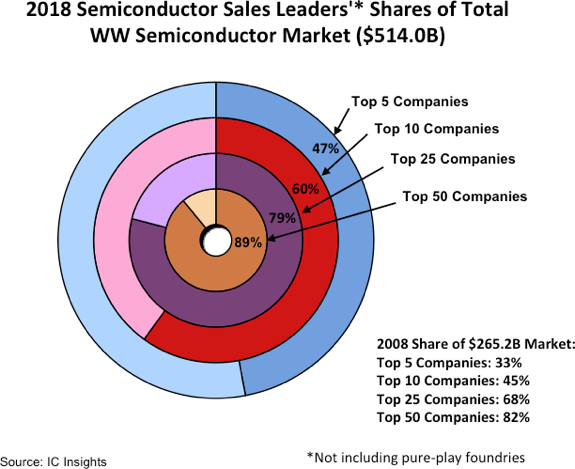
Research included in the new McClean Report shows that the world’s leading semiconductor suppliers significantly increased their marketshare over the past decade.  The top 5 semiconductor suppliers accounted for 47% of the world’s semiconductor sales in 2018, an increase of 14 percentage points from 10 years earlier (Figure 1).  In total, the 2018 top 50 suppliers represented 89% of the total $514.0 billion worldwide semiconductor market last year, up seven percentage points from the 82% share the top 50 companies held in 2008.

As shown, the top 5, top 10, and top 25 companies’ share of the 2018 worldwide semiconductor market increased 14, 15, and 11 percentage points, respectively, as compared to 10 years earlier in 2008.  With additional mergers and acquisitions expected over the next few years, IC Insights believes that the consolidation could raise the shares of the top suppliers to even loftier levels.

There was a wide 66-percentage point range of year-over-year growth rates among the top 50 semiconductor suppliers last year, from +56% for Nanya to -10% for Fujitsu.  Nanya rode a surge of demand for its DRAM devices to post its great full-year results.  However, evidence of a cool down in the memory market last year was evident in the company’s quarterly sales results, which saw its sales drop from $826 million in 2Q18 to $550 million in 4Q18 (a 33% plunge).  Overall, four of the top seven growth companies last year—Nanya, SK Hynix, Micron, and Samsung—were major memory suppliers.  Although Nanya registered the highest percentage increase, Samsung had the largest dollar volume semiconductor sales increase, a whopping one-year jump of $17.0 billion!

In total, only nine of the top 50 companies registered better growth as compared to the 2018 worldwide semiconductor market increase of 16%, with five companies logging increases of ≥30%.  In contrast, only three of the top 50 semiconductor companies logged a decline in sales last year, with Fujitsu being the only company to register a double-digit sales drop.
Semiconductor Leaders’ Marketshares Swell Over the Past 10 Years

("Note: The information presented in this article is gathered from the internet and is provided as a reference for educational purposes. It does not signify the endorsement or standpoint of our website. If you find any content that violates copyright or intellectual property rights, please inform us for prompt removal.")

Online messageinquiry

reading
New Thermal Management Breakthrough: GaN-on-Sapphire Substrate Thinned to 50μm
  Recently, China-based Ziener Tech has unveiled progress in sapphire substrate thinning, announcing that it has successfully reduced the substrate thickness of its 8-inch GaN-on-sapphire wafers to 50μm.  In practical applications, heat dissipation has long been a key bottleneck limiting GaN device performance. Substrate material plays a critical role in thermal management. Sapphire offers strong insulation, high thermal stability, and relatively good lattice and thermal matching with GaN, enabling simpler epitaxial structures. However, its inherently low thermal conductivity has historically constrained heat dissipation. Thinning the substrate effectively shortens the thermal conduction path, thereby improving overall device thermal performance.  The company’s advancement lies in precise control of the substrate thinning process. According to Ziener, as substrate thickness was gradually reduced from the conventional 200μm to 100μm and ultimately to 50μm, device thermal performance improved significantly. Test data show that at 200μm, the junction-to-case thermal resistance is 1.6°C/W, comparable to silicon-based GaN devices. At 100μm, thermal resistance drops to 1.1°C/W, outperforming silicon-based solutions. At 50μm, it further decreases to 0.8°C/W—about half that of comparable GaN-on-silicon devices.  Benefited from the improved thermal resistance, GaN-on-sapphire devices demonstrate clear thermal advantages over GaN-on-silicon counterparts in real-world applications. Under high-power conditions across various voltages and loads, Ziener’s devices consistently deliver lower temperature rise than competing silicon-based GaN devices, highlighting superior heat dissipation capability.  Further validation in application scenarios also quantifies the impact of substrate thickness on device temperature. In tests conducted on a high-power totem-pole PFC power board, Ziener compared devices with 100μm and 50μm substrates. Results show that at 90 V input, the case temperature of the 50μm device is reduced by 13.6°C compared to the 100μm version; at 264 V input, the reduction reaches 14.5°C. Across multiple voltage and load conditions, GaN-on-sapphire devices consistently deliver lower temperature rise than equivalent GaN-on-silicon devices.  Notably, Ziener also disclosed that it has completed technical development for an ultra-thin 30μm sapphire substrate, indicating further room for thermal performance improvement. For high power density and high-efficiency system applications, substrate thinning offers a viable pathway to overcoming thermal challenges in GaN devices.  Industry analysts note that as the power semiconductor market increasingly demands higher efficiency, reliability, and compact form factors, advancements in substrate technology—an upstream cornerstone—will directly shape downstream competitiveness. GaN-on-sapphire already holds advantages in breakdown voltage and reliability in medium- to high-voltage applications. Continued progress in thermal management is expected to expand its adoption across a broader range of high-power scenarios.
2026-04-27 10:37 reading:279
TSMC’s U.S. Factory Plans Small-Scale Trial Line for Q1 2024
  According to a report by Taiwan’s Money DJ, the production schedule for TSMC’s semiconductor foundry in the United States has been delayed until 2025, raising concerns among observers. However, Chairman Mark Liu, in an interview on the 6th, stated that there has been significant progress over the past five months and expressed confidence in the project’s success. Industry sources have indicated that TSMC’s U.S. facility may alter its ramp-up strategy by first establishing a mini-line for trial production, with the expectation of having it in place by the first quarter of 2024.  TSMC’s Fab 21 Phase 1 construction began in April 2021, originally slated for early 2024 production. However, challenges such as a shortage of skilled equipment installation personnel, local union protests, and differences in overseas safety regulations have caused delays in equipment installation. This has compelled TSMC to adjust its plans, and the expected production timeline is now set for 2025, representing a one-year delay.  Industry analysts have noted that the efficiency of equipment entering the facility at TSMC’s U.S. plant in Arizona is only about one-third of that of its Taiwan facilities. Given the current pace of progress, the time required for equipment setup to actual production could be substantial. Therefore, TSMC has decided to change its previous ramp-up strategy and first establish a mini-line with an initial estimated monthly capacity of about 4,000 to 5,000 wafers. This approach aims to ensure some level of production output while mitigating potential contract breach issues arising from delays in production.
2023-09-08 17:00 reading:4232
How can semiconductor manufacturers reduce their CO2 emissions
  Semiconductor manufacturers can’t reduce CO2 emissions and energy consumption without digital technology and an end-to-end strategy  Semiconductor manufacturers are in a challenging position – they need to fulfill soaring chip demand while at the same time decarburizing their supply chain. The industry already has a giant carbon footprint and as it grows, so does its carbon footprint.  Semiconductors facilitate the ongoing shift from traditional vehicles to mobility solutions: focussing on connectivity, autonomous driving, electrification and low carbon mobility. Semiconductors help redefine mobility, reduce emissions and help alleviate congestion.  Emission reduction in vehicles and in transportation systems is made possible by semiconductor-based in-vehicle networks and sensors that increase fuel efficiency by reducing vehicle weight. Battery control and energy management semiconductor solutions extend the distance range of electric and hybrid transport and improve the predictability of that range: increased distance range is key to mass adoption of Electric vehicles.  Certain companies in the semiconductor industry have focused on sustainability for a significant period of time. ST Microelectronics and Intel have long records of focusing on water conservation and programs to reduce power. However, the Paris Accord and the recent article published in Bloomberg, accusing the semiconductor industry of having a giant carbon footprint, have initiated a new call to arms, or at least a more concerted effort on reducing the semiconductor industries carbon footprint.  Sustainability can be challenging, and while larger companies can dedicate resources to focusing on sustainability, smaller companies that support the semiconductor industry may not be able to support a dedicated Environmental Social Governance (ESG program). SEMI has picked up the ball over the past year and now is working to provide guidance and eventually standards such that the semiconductor manufacturing community can address sustainability as an industry, instead of company by company.
2023-07-17 15:04 reading:4188
Cutting edge transistors for semiconductors of the future
  As traditional transistors reach the threshold of their miniaturization potential, the ability to incorporate multiple functionalities within a limited number of units becomes crucial for facilitating the creation of compact, energy-efficient circuits. This, in turn, paves the way for enhanced memory capabilities and the realization of more potent computing systems.  Transistors that can change properties are important elements in the development of tomorrow's semiconductors. With standard transistors approaching the limit for how small they can be, having more functions on the same number of units becomes increasingly important in enabling the development of small, energy-efficient circuits for improved memory and more powerful computers. Researchers at Lund University in Sweden have shown how to create new configurable transistors and exert control on a new, more precise level.  Transistors that can change properties are important elements in the development of tomorrow's semiconductors. With standard transistors approaching the limit for how small they can be, having more functions on the same number of units becomes increasingly important in enabling the development of small, energy-efficient circuits for improved memory and more powerful computers. Researchers at Lund University in Sweden have shown how to create new configurable transistors and exert control on a new, more precise level.  In view of the constantly increasing need for better, more powerful and efficient circuits, there is a great interest in reconfigurable transistors. The advantage of these is that, in contrast to standard semiconductors, it is possible to change the transistor's properties after they have been manufactured.  Historically, computers' computational power and efficiency have been improved by scaling down the silicon transistor's size (also known as Moore's Law). But now a stage has been reached where the costs for continuing development along those lines has become much higher, and quantum mechanics problems have arisen that have slowed development.  Instead, the search is on for new materials, components and circuits. Lund University is among the world leaders in III-V materials, which are an alternative to silicon. These are materials with considerable potential in the development of high-frequency technology (such as parts for future 6G and 7G networks), optical applications and increasingly energy-efficient electronic components.  Ferroelectric materials are used in order to realize this potential. These are special materials that can change their inner polarization when exposed to an electric field. It can be compared to an ordinary magnet, but instead of a magnetic north and South Pole, electric poles are formed with a positive and a negative charge on each side of the material. By changing the polarization, it is possible to control the transistor. Another advantage is that the material "remembers" its polarization, even if the current is turned off.  Through a new combination of materials, the researchers have created ferroelectric "grains" that control a tunnel junction—an electrical bridging effect—in the transistor. This is on an extremely small scale—a grain is 10 nanometers in size. By measuring fluctuations in the voltage or current, it has been possible to identify when polarization changes in the individual grains and thus understand how this affects the transistor's behavior.  - The Future of the Semiconductor Industry  In addition to the upstream IC design, the midstream foundry, the DRAM industry, and the downstream packaging and testing, photomask, equipment and other industries, semiconductors have a huge group, and the application of semiconductors has also expanded to the electronic information industry, automotive electronics, Aerospace, medical, precision machinery and other industries.  While the future of the semiconductor industry looks bright, no one knows with certainty where it’s headed. The direction it moves in depends on many factors, which include the following:  · the experimentation with new semiconductor materials  · the increase in the price of rare earth metals  · the accelerated industrial adoption of new technologies in artificial intelligence (AI), the Internet of Things (IoT), and related fields  These factors and others will inevitably impact sales, create opportunities, and present fresh challenges.  At our core, we have a passion to create a better world by making electronics more affordable through semiconductors. This passion is alive today as we continue to pioneer advances in integrated circuits. Each generation of innovation builds upon the last to make technology smaller, more efficient, more reliable and more affordable. Contact us today to learn more about the services provided by Ameya360.
2023-07-11 11:46 reading:3888
  • Week of hot material
  • Material in short supply seckilling
model brand Quote
CDZVT2R20B ROHM Semiconductor
TL431ACLPR Texas Instruments
BD71847AMWV-E2 ROHM Semiconductor
MC33074DR2G onsemi
RB751G-40T2R ROHM Semiconductor
model brand To snap up
BP3621 ROHM Semiconductor
ESR03EZPJ151 ROHM Semiconductor
STM32F429IGT6 STMicroelectronics
TPS63050YFFR Texas Instruments
IPZ40N04S5L4R8ATMA1 Infineon Technologies
BU33JA2MNVX-CTL ROHM Semiconductor
Hot labels
ROHM
IC
Averlogic
Intel
Samsung
IoT
AI
Sensor
Chip
About us

Qr code of ameya360 official account

Identify TWO-DIMENSIONAL code, you can pay attention to

AMEYA360 weixin Service Account AMEYA360 weixin Service Account
AMEYA360 mall (www.ameya360.com) was launched in 2011. Now there are more than 3,500 high-quality suppliers, including 6 million product model data, and more than 1 million component stocks for purchase. Products cover MCU+ memory + power chip +IGBT+MOS tube + op amp + RF Bluetooth + sensor + resistor capacitance inductor + connector and other fields. main business of platform covers spot sales of electronic components, BOM distribution and product supporting materials, providing one-stop purchasing and sales services for our customers.

Please enter the verification code in the image below:

verification code